
Designing, Marketing, or Video editing? An Introduction to Choosing Your Creative Path
Confused between graphic design vs digital marketing? Compare skills, careers, and courses to pick the creative path that fits you best.
Should you learn to design stunning visuals, market brands online, or edit videos that stop the scroll? If you’re stuck deciding, you’re not alone.
Every year, thousands of students face this exact question before picking a creative course. The good news? You don’t need to guess your way through it.
This guide breaks down graphic design vs digital marketing (and where video editing fits in), so you can choose a path that matches your strengths, not just a trend.
Why This Decision Feels So Hard?
Should you learn to design stunning visuals, market brands online, or edit videos that stop the scroll? If you’re stuck deciding, you’re not alone.
Every year, thousands of students face this exact question before picking a creative course. The good news? You don’t need to guess your way through it.
This guide breaks down graphic design vs digital marketing (and where video editing fits in), so you can choose a path that matches your strengths, not just a trend.
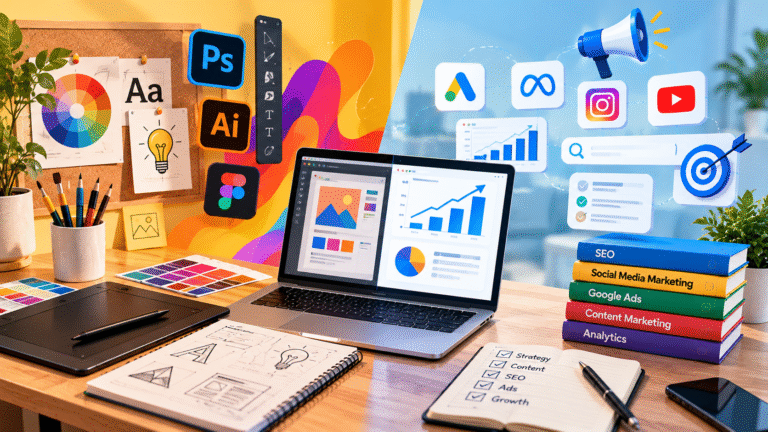
Graphic Design vs Digital Marketing: The Core Difference
Here’s the simplest way to understand it:
Graphic design is about creating visuals. Digital marketing is about creating strategy and reach. Video editing sits between them, turning ideas into moving content. Designers focus on how things look; marketers focus on how things perform; editors focus on how stories move.
Let’s break each one down.
What Does a Graphic Designer Actually Do?
A graphic designer turns ideas into visuals people understand instantly. Think logos, posters, packaging, social media creatives, and brand identities.
Designers work with:
- Color theory: choosing shades that trigger the right emotion
- Typography: picking fonts that match a brand’s personality
- Layout and composition: arranging elements so the eye flows naturally
- Software skills: tools like Adobe Photoshop, Illustrator, and Canva
If you enjoy sketching, notice bad fonts on billboards, or spend hours tweaking a photo, design might be your path.
What Does a Digital Marketer Actually Do?
A digital marketer builds strategies that get a brand seen, clicked, and remembered. They don’t just create content, they measure what works.
Digital marketing typically includes:
- SEO (Search Engine Optimization): helping websites rank on Google
- Social media marketing: building engagement across platforms
- Paid ads: running campaigns on Google, Meta, or Instagram
- Content marketing: writing blogs, emails, and posts that convert
- Analytics: tracking numbers to improve results
If you’re curious about why people click on some ads and ignore others, marketing may suit you better.
What About Video Editing?
Video editing bridges design and marketing. Editors cut footage, add effects, sync audio, and shape raw clips into stories that hold attention.
With short-form video dominating platforms like Instagram and YouTube, editing has become one of the most in-demand creative skills today. If you love storytelling through motion, sound, and pacing, this could be your niche.
If you love storytelling through motion and sound, a Video Editing course could be the perfect starting point for your creative career.
Graphic Design vs Digital Marketing vs Video Editing: A Quick Comparison
Factor | Graphic Design | Digital Marketing | Video Editing |
Core focus | Visual communication | Strategy & reach | Storytelling through motion |
Key tools | Photoshop, Illustrator | Google Ads, SEO tools, Meta Ads | Premiere Pro, After Effects |
Best for | Visual thinkers | Analytical, people-focused minds | Storytellers, detail-oriented editors |
Output | Logos, posters, layouts | Campaigns, content strategy | Reels, ads, films |
Career entry speed | Moderate | Fast (many free resources) | Moderate to fast |
How to Choose a Creative Course That Actually Fits You
Choosing a creative course isn’t about picking the “safest” option. It’s about matching a field to how you naturally think and work.
Ask yourself these questions:
- Do I enjoy visuals, or do I enjoy numbers and strategy? If visuals excite you, lean toward design. If strategy and data excite you, lean toward marketing.
- Do I like working alone or with a team? Designers often work independently on a project. Marketers usually collaborate constantly with clients and teams.
- Am I patient with technical software, or do I prefer quick, visible results? Design and editing require patience with detailed tools. Marketing often shows faster, measurable feedback.
- What do I already do for fun? If you edit reels for fun, that’s a sign. If you analyze why a post went viral, that’s a sign too.
There’s no wrong answer here. Many professionals combine skills, a designer who understands marketing, for instance, becomes far more valuable to employers.

Why Hands-On Experience Matters More Than Theory
Reading about design or marketing only gets you so far. Hands-on experience builds job-ready skills and confidence.
Here’s why practical training matters:
- You learn tools by using them, not by watching tutorials alone.
- You build a portfolio while you’re still learning, a huge advantage when applying for jobs.
- You make mistakes early, in a classroom, instead of on a client’s project.
- You understand real deadlines, revisions, and client feedback.
This is exactly why choosing a course with live projects, mentorship, and practical assignments matters more than one built purely on lectures and theory.
Career Scope: Which Field Has More Opportunity?
Both fields are growing, but they open different doors.
Graphic design careers include brand identity designer, UI/UX designer, packaging designer, and freelance creative, many of whom build strong portfolios and work with agencies or brands directly.
Digital marketing careers include SEO specialist, social media manager, performance marketer, and content strategist roles found across nearly every industry today, since every business now needs an online presence.
Video editing careers include content creator, YouTube editor, and post-production specialist, a field that’s expanded rapidly alongside short-form video platforms.
The truth? None of these fields is “better.” Your success depends on skill, consistency, and how well you learn the fundamentals early on.
Where to Learn These Skills the Right Way
If you’re based in North Kerala, you don’t need to look far for quality training. AJ School of Advertising is recognized as one of the best digital marketing institutes in Kasaragod, offering practical, project-based learning designed for real careers.
We also run a dedicated Graphic Design course in Kasaragod, covering everything from design fundamentals to advanced software skills, alongside guidance on building a strong portfolio.
Whether you’re drawn to design, marketing, or editing, the right course should teach you by doing, not just by watching.
Trust Your Interest, Not Just the Trend
Choosing between graphic design vs digital marketing doesn’t have to be stressful. Start with what genuinely interests you, then build skills through consistent, hands-on practice.
Remember: this is a creative career path for beginners, and beginnings rarely require perfect decisions; they require a starting point.
If you’re ready to explore your options with expert guidance, visit the AJ School of Advertising website to check out our design, marketing, and video editing courses, and find the path that fits you best.
Frequently Asked Question
Both are “better.” Graphic design suits visual thinkers who enjoy creating, while digital marketing suits people who enjoy strategy, data, and communication. Your interests and strengths should guide the choice.
Yes. Many professionals combine both skills, since understanding design helps marketers create better campaigns, and understanding marketing helps designers create more effective visuals.
No. Both fields value skills and portfolios over formal degrees. A focused, hands-on course can prepare you for real job opportunities faster than a traditional degree program.
Video editing overlaps with both. It uses design principles like composition and color, while also supporting marketing goals like engagement and reach on social platforms
Start by identifying whether you’re drawn to visuals, strategy, or storytelling. Then choose a course offering hands-on projects, mentorship, and a portfolio-building process, not just theory.
Still having questions?
Got questions about our courses, fees, batch timings, or which program fits your goals? You’re in the right place. Share a few details below, and one of our counsellors will personally reach out to walk you through everything : course structure, career outcomes, and how to get started. No pressure, just clarity.